Publication
Accepted papers appeared in E3S Web of Conferences. This page records the journal, the sizing rules, the article structure and the open access terms that applied.
A proceedings volume with a public record
Accepted work was published in E3S Web of Conferences, an open access journal for conference proceedings. The journal carries the eISSN 2267 1242 and deposits each volume in a set of abstract and citation services.
Each author could appear as author or coauthor in at most two papers. The page range for a paper was six to ten pages.
Archive note: the publication route below describes the 2019 edition. Always confirm current requirements with the publisher before submitting new work.
Indexing recorded by the journal
- Scopus
- Web of Science
- DOAJ
- ProQuest
- EBSCO
- Google Scholar
- NASA ADS
- CAS
- Agricultural and Environmental Science Database
- Materials Science and Engineering Database
- SciTech Premium Collection
- Technology Collection
Page and text rules
The template set a common frame so that all papers in the volume could be read as one continuous proceedings record.
| Item | Requirement |
|---|---|
| Paper size | 170 by 250 millimetres |
| Top margin | 2.4 centimetres |
| Left and right margins | 2.0 centimetres each |
| Bottom margin | 1.6 centimetres |
| Line spacing | Single |
| Page numbers | Omitted, with no running headers or footers |
| Page orientation | Portrait; landscape pages rotated |
| Figures | Placed in the text, not collected at the end |
| References | Checked for accuracy and cited in order |
Before submission
Check the author names and full affiliation addresses, including country. Read the text for clarity and consistent English. Make sure every figure and table is cited in the body and every reference is complete.
Proofread the final file. The publisher expects a clean manuscript that matches the template rather than a file that needs later reconstruction.
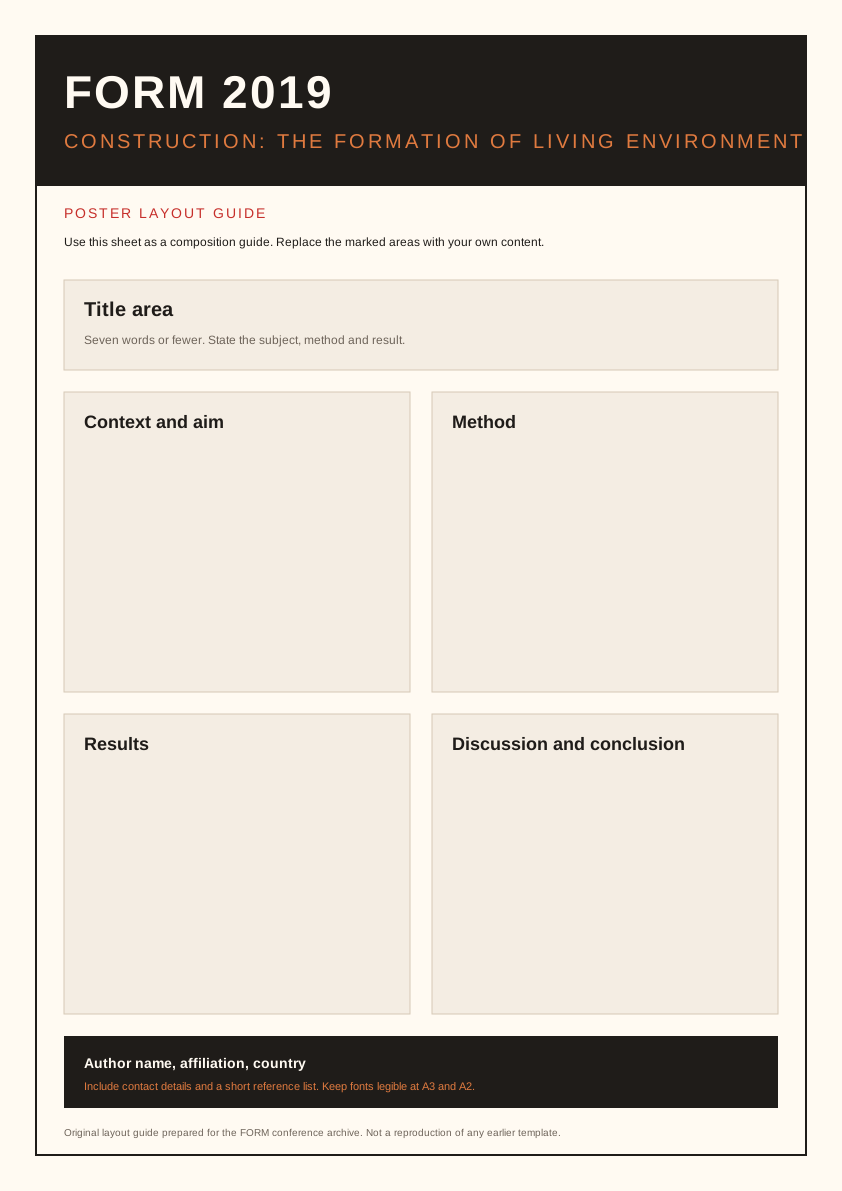
The article skeleton
The conference used the IMRAD pattern. The notes below explain what belongs in each part in plain terms.
Title
Keep the title to seven words or fewer, not counting short connecting words. Write it as a label rather than a sentence, and choose specific nouns over broad labels that tell the reader little.
Abstract
Write 200 to 250 words that can stand alone. Follow the order of the paper: frame the problem, state the aim, describe the method, report the main findings and close with the conclusion. Do not refer to sections or figures that the reader cannot see in the abstract.
Keywords
Give five to ten words or short phrases that a reader would use when searching for the work.
Introduction
Set out the purpose and background. Use a focused literature review that shows command of the field, with five to ten closely relevant sources rather than a long list.
Methods
Describe the experimental setup, materials, instruments and procedure in enough detail for another researcher to understand what was done.
Results
Present the findings clearly and concisely. Use figures and tables where they carry the data better than prose.
Discussion
Explain the relationships in the results, assess their significance and compare them with published work.
Conclusions
State the main conclusions as general claims that follow from the results. Do not repeat the results section line by line.
Acknowledgements
Name the people and funders who supported the work, and state any funding information required by the publisher.
References
Use a numbered list in order of mention, with square brackets in the text. The conference guidance recommended about twenty sources, chosen for relevance and recency.
Author rights and reuse
The author kept ownership of the text. The publisher received a licence to publish and distribute the article, and readers could reuse it when they credited the source.
The exact open access terms are set by the publisher. This archive does not reproduce the legal text of the agreement.
Publication contacts
Questions about the volume should go to the scientific policy desk at MGSU or to the publisher. The contact page records the conference desks.